A history worth keeping
This site tells the story of Romanian football clubs in international club competitions, from their first appearances in the Central European Cup in 1937 to the present day.
This is an independent, unofficial archive, created for supporters who want to discover, revisit and better understand that history. It brings together information from publicly available sources, including UEFA, club websites, national football associations, professional leagues, Wikipedia and other historical football archives.
European nights worth remembering
Romanian clubs have not enjoyed the sustained European success of the continent’s strongest football nations. Yet their history contains achievements that deserve to be remembered and celebrated.
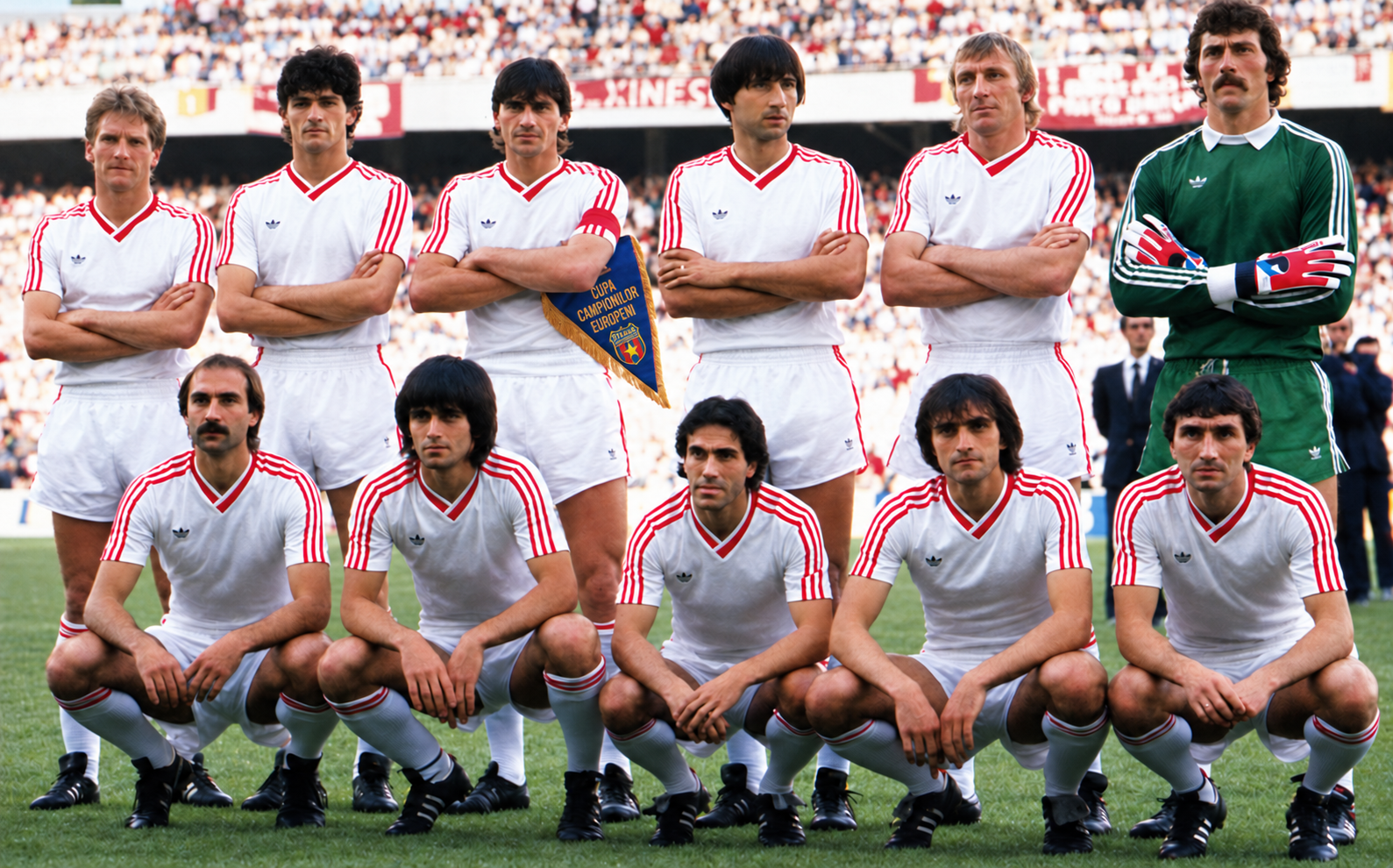
Steaua București’s European Cup and European Super Cup triumphs stand at the summit. Dinamo București and Universitatea Craiova also reached European semi-finals, coming close to finals that might have changed their histories. The 1980s remain the outstanding decade for Romanian club football on the main European stage, while Steaua (FCSB)’s run to the UEFA Cup semi-finals in 2005/06 provided another unforgettable chapter.
Romanian clubs have also produced remarkable results against some of Europe’s biggest names, sometimes overcoming odds that seemed almost impossible. UTA Arad eliminated reigning European champions Feyenoord, while Dinamo București knocked out another defending champion, Hamburger SV. Oțelul Galați’s home victory over Juventus provided another memorable upset. Such moments did not always lead to a trophy or a long European run, but they gave supporters unforgettable nights and deserve their place in this history.
Romanian clubs also found success in regional tournaments and other European competitions. These honours carry a different weight, but they remain an important part of the story, strengthening clubs’ reputations and giving supporters memorable European encounters.
Steagul Roșu Brașov, Rapid București, Sportul Studențesc and Inter Sibiu won the Balkans Cup. Oțelul Galați and FC Vaslui recorded final-round successes in the Intertoto Cup. Rapid București also reached the Central European Cup final in 1940—a final that was never played.
The competitions in this archive
To distinguish between these different achievements, the site uses two categories:
- Principal Competitions: European Cup / Champions League, Cup Winners’ Cup, UEFA Cup / Europa League, Conference League, Inter-Cities Fairs Cup, European Super Cup and Intercontinental Cup.
- Secondary Competitions: Central European Cup / Mitropa Cup, Balkans Cup and Intertoto Cup.
This is the archive’s own classification, rather than an official UEFA designation. Both categories form part of the historical record, but only the Principal Competitions contribute to the Success Indices described below.
A different way to explore success
Results tell us what happened. They also invite a question: how successfully did each club use its opportunities in Europe?
With this question in mind, we developed the Success Index, one of this site’s original features. Two separate models offer complementary perspectives on Romanian football’s European record.
The Romanian clubs’ Success Index assesses performance through progression, match results, points and bonuses, and goal balance. Scores and rankings appear throughout the site, with the methodology explained on the Success Index page.
The Success Index against opponent teams and countries explores how Romanian clubs have performed against each opponent and football association. It combines match success, knockout qualification and group or unique-group qualification outcomes, using a separate formula.
Together, these models help visitors explore questions such as: which Romanian clubs made the most of their European appearances? Against which opponents did Romanian clubs enjoy the greatest success? Which countries proved the hardest to overcome?
Both Success Index formulas were developed for this website. They are original, unofficial assessments and do not represent the position of UEFA, the Romanian Football Federation, any club or any other football authority.
Their purpose is to look beyond the total number of appearances, victories or trophies. A club with decades of European participation has had very different opportunities from a club that appeared in a single edition. The indices offer another way to examine their records, alongside the underlying results.
No formula can capture every difference between footballing eras, competition formats or the strength of opponents. A high score from a short European campaign should therefore be read with its context and sample size in mind. The formulas, components and limitations are documented so visitors can understand how the scores are calculated and form their own opinions.
Help improve the archive
This site is a continuing project. Historical records can be incomplete, sources sometimes disagree, and there will always be details to clarify or improve.
Corrections, additional information and constructive feedback are welcome—whether they concern a match, a club’s history, the Success Index or the experience of using the site.
You can get in touch through Contact & feedback, linked in the footer.
Above all, this site is dedicated to everyone who believes Romanian football’s European history is worth keeping.
Archive notes & sources
About the archive
Romanian clubs’ European journeys, explored through seasons, club profiles, country directories and opponents.
Reading the records
Scores show the Romanian club first. The 1,653 supplied rows replace the earlier partial import; the two sourced finals enrich their matching rows rather than adding duplicates. Blank scores stay unspecified, except the 1940 Rapid–Ferencváros final, now identified as not played and excluded from scored and unknown-result counts. Repeated rows are retained, including one identical source row, because identical scores alone do not establish duplicate matches. Reciprocal entries involving two Romanian clubs remain as supplied, so entry counts are not necessarily counts of unique fixtures.
Decades follow the season’s starting year: 1980/81–1989/90 belongs to the 1980s. Single-year and multi-year editions are filed by their starting year and use consistent edition labels: a slash separates different years, while repeated years are shown once. As an archive navigation exception, the 1930s group also contains the 1940s entries, including the 1940 Central European Cup final. For example, a repeated-year edition is displayed as a single calendar year.
Names and countries
The current-name columns link club profiles while historical names and associations remain in match rows. Romanian names in match rows follow the historical naming instructions supplied by the owner. Naming ranges are used internally and are not presented as a timeline. Steaua (FCSB) București and FCSB București share a profile separate from the earlier Steaua București. Viitorul Constanța appears under its name in the relevant records within the Farul profile. Full display names are normalised where already established. Present-day country pages distinguish matches under that association from earlier historical-association records. Germany labels are retained as supplied; West Germany is not inferred. The owner's mappings require historical review before being treated as definitive club succession.
Competitions and missing details
Historical competition names remain in the results. European Cup and Champions League share a competition profile; UEFA Cup and Europa League share another. Inter-Cities Fairs Cup and Intercontinental Cup are classified separately from UEFA tournaments. Intertoto entries use the stated edition year to distinguish the pre-1995 tournament from UEFA's competition. Stages and Home/Away/Neutral venues are added where the owner’s spreadsheet matches the archive. SF means Quarter-finals, SmF means Semi-finals, and II-16z means Knockout round play-offs. Other supplied codes are expanded to their full names. I, II and III are displayed as First, Second and Third round. Conflicting scores and competition labels are retained for review rather than silently overwritten. Column C is evaluated across the whole round: if any row is 1, the Romanian team is bold and marked Qualified on every row in that tie or group. Knockout ties are grouped by season, club, competition, round and opponent; group/league phases include all opponents in that phase. Multiple 1 markers count as one qualification. A blank or all-zero group does not receive a qualification label. Winning finals are labelled Winner. Column Q supplies R for a deciding third match or D for an away-goals decision. Green means the Romanian team qualified and red means it was eliminated. Columns O/P contain the penalty shoot-out score, Romanian team first, using the same outcome colours. These scores are kept separate from the match score. Final outcomes are labelled Won final or Lost final. Blank cells do not imply an outcome. No general chronology of extra-time or penalty rules is inferred from R.
Names and terminology
Profiles, rankings, navigation and search use consistent English club display names, retaining accents in proper names. Historical match records retain the club name used at the time, shown with the same English naming convention where applicable. Original supplied names remain available for search. A season is counted once by its starting year. A competition entry means one club in one competition in one season; transfers create separate entries. Match is used throughout for an individual fixture. Table abbreviations: W = wins, D = draws, L = defeats, GF = goals for and GA = goals against. UK English is used for football terms, including quarter-finals, draws, defeats and penalty shoot-outs.
Sources
Owner-supplied TSV, 19 October 2026. The original source columns and matched spreadsheet rows, including TUR codes and venue markers, are retained in the underlying records. Edition markers are not used to infer dates, rounds or venues.