The encounter
Final not played · no winner declared
Match cassette · results and dates
Romanian club’s score first.
- Final · not playedRapid București Not played Ferencvárosi TC (Hungary)
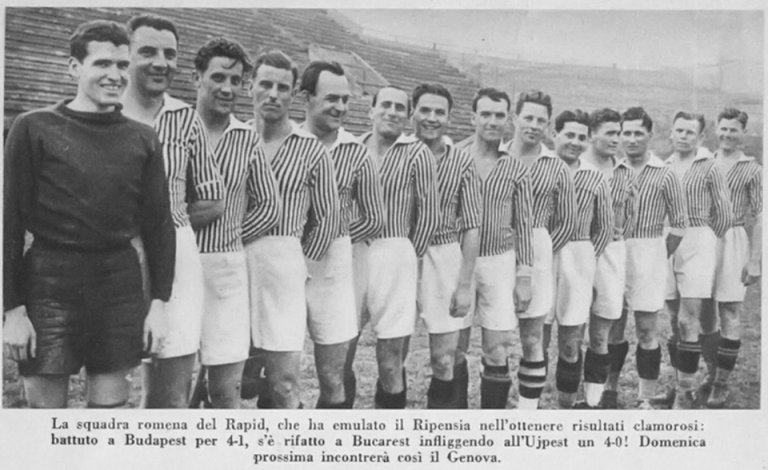
A final before the European Cup era
Long before the European Cup existed, the Central European Cup — also known as the Mitropa Cup — brought leading clubs from across the region together. By 1940, war had already changed the competition and the world around it. Rapid București nevertheless embarked on a journey that would take the club to a final against Ferencváros, and into a chapter of football history with no final match.
A statement in Budapest
Rapid’s first opponents were Hungária of Budapest. On 16 June, the home side scored first, but Vilim Šipoš equalised before half-time and struck again after the interval. The 2–1 victory gave Rapid an advantage to carry home; Rapid’s own account describes it as the first victory by a Romanian team in Hungary.
Three goals in București
A week later, the return began with Šipoš scoring early. Ion Bogdan added another before the break, and Iuliu Barátky completed a 3–0 win. Rapid had beaten Hungária in both legs, 5–1 on aggregate, and a semi-final against Građanski Zagreb awaited.
Two goalless semi-finals
In Zagreb, Rapid held Građanski to a 0–0 draw. The return in București brought another match without a goal. The tie was still level after 180 minutes, and the teams had to meet for a third time, this time in Subotica.
A goal, a draw and the luck of the draw
Rapid travelled to the play-off without several important players. Građanski scored early, but Bogdan equalised. The score remained 1–1 through extra time, leaving the organisers to draw lots under the rules of the time. Rapid’s name was drawn: after three matches and no defeat, the club had reached the final.
The final that never came
Ferencváros were to provide the opposition, but the final was never played. The war and the political tensions of the period had overtaken the competition. No winner was declared, and there is no final score to record. Rapid’s journey remains remarkable for what the team achieved on the pitch — two victories and three draws — and for the final it never had the opportunity to contest.
Match facts
- Competition
- Central European Cup (Mitropa Cup) · 1940
- Quarter-final
- Hungária 1–2 Rapid; Rapid 3–0 Hungária · Rapid won 5–1 on aggregate.
- Semi-final
- Građanski 0–0 Rapid; Rapid 0–0 Građanski; play-off at Subotica: Građanski 1–1 Rapid after extra time · Rapid advanced by drawing lots.
- Final
- Rapid v Ferencváros · not played; no winner declared.
Team line-ups
Starting players; substitutes are included where recorded · GK = goalkeeper · C = captain.
Quarter-final first leg · Budapest · 16 June 1940
- Rapid București
- Petre Rădulescu; Iosif Slivatz, Iosif Lengheriu, Vintilă Cossini, Gheorghe Rășinaru, Ioachim Moldoveanu, Vilim Šipoš, Ioan Wetzer, Iuliu Barátky, Dan Gavrilescu, Ion Bogdan.
- Coach
- Ștefan Auer.
Semi-final play-off · Subotica
- Rapid București
- Petre Rădulescu; Iosif Slivatz, Iosif Lengheriu, Ion Costea, Ioan Wetzer, Ioachim Moldoveanu, Radu Florian, Francisc Simkó, Iuliu Barátky, Dan Gavrilescu, Ion Bogdan.
- Coach
- Ștefan Auer.
Line-ups follow the match reports linked in Sources & image credits.
Explore the archive
Sources & image credits
About the historical details and source differences
Narrative and Rapid line-ups adapted from FC Rapid’s account; the competition results are also documented by RSSSF. The final was not played.
Match results and dates follow the archive records. Reference pages:
Club crest: the image already stored in the club archive, used as a visual identifier rather than a photograph of this encounter.
← All European stories